3D Laser Scanning for Toronto Restoration Projects: Accurate Measurements for Success
How 3D Laser Scanning Boosts Toronto Renovations .
As someone who has actually operated in the 3D scanning industry for some time, I have actually seen firsthand just how modern technology has transformed the way we approach construction and renovation projects. One of the most powerful devices offered today is 3D laser scanning, which has actually shown to be a game-changer for experts in Toronto who are involved in remodelling projects. Whether it's household, business, or industrial rooms, the accuracy, speed, and efficiency of 3D laser scanning make it a important part of the restoration process. In this write-up, I'm going to share my experiences and understandings on just how 3D laser scanning boosts remodelling projects in Toronto, ensuring specific measurements and inevitably resulting in even more successful outcomes.
What is 3D Laser Scanning?
Prior to diving right into the details benefits of 3D laser scanning for renovations, it's important to recognize what the innovation involves. 3D laser scanning is a process that catches detailed, high-precision measurements of physical areas utilizing laser light to develop accurate digital representations. The scanner emits laser light beams that jump off surface areas and go back to the scanner, computing the range to each point. By doing this at countless points per 2nd, the scanner produces a point cloud-- a thick, three-dimensional collection of information points that form a extremely precise digital model of the room.
This data can be exchanged a range of formats, including CAD (Computer-Aided Design) data, which are vital for architects, designers, designers, and contractors dealing with remodelling projects. With this innovation, specialists can see every information of a structure or area-- to millimeters-- before any type of work starts.
The Significance of Accurate Measurements in Renovation Projects
On the planet of remodelling, precision is whatever. A single miscalculation or ignored dimension can lead to costly mistakes, delays, and also structural problems. For tasks in Toronto, a city recognized for its aging framework, varied architectural designs, and complicated building regulations, precision ends up being a lot more important. Restorations commonly include dealing with existing structures, which can present covert challenges such as irregular floors, obsolete electrical wiring, and changing foundations. For that reason, it's important that the dimensions taken previously and during the project are exact to avoid pricey reworks or conformity issues.
Conventional measurement approaches, like tape measures or manual surveying, are still used by some, however these approaches are prone to human error. As somebody who has actually directly worked on numerous improvement projects, I can attest that the tiniest error can snowball right into bigger problems down the line. That's where 3D laser scanning radiates-- by offering very thorough and precise information, it guarantees that all measurements are trusted and accurate, from the first stage to the roofing system.
Advantages of 3D Laser Scanning for Toronto Renovations
Now, let's check out the specific advantages that 3D laser scanning offers remodelling projects in Toronto.
1. Improved Accuracy
One of the biggest advantages of 3D laser scanning is the level of precision it provides. In renovation tasks, having an specific digital version of the existing space aids experts avoid the mistakes that come with hand-operated measurements. The laser scanner records measurements with severe precision-- frequently to within millimeters-- and creates a digital version that accurately stands for the physical space. This level of detail is indispensable for developing renovations that fit flawlessly within the existing framework.
For example, during a current improvement job in downtown Toronto, we made use of 3D laser scanning to catch the interior of a 100-year-old structure that was being repurposed for contemporary office space. The structure had cleared up with time, creating shifts in the alignment of walls, floorings, and home windows. With standard measurement methods, it would certainly have been tough to account for these subtle adjustments. Nevertheless, with 3D scanning, we had the ability to obtain a detailed digital design that helped us design new aspects to fit precisely within the existing framework.
2. Rate and Effectiveness
In Toronto, restoration timelines are frequently limited because of different variables, including city authorizations, weather conditions, and the demands of clients. Typical measuring and surveying methods can be time-consuming, particularly for large or complicated rooms. This is where 3D laser scanning actually shows its worth.
A laser scan can cover large locations promptly, recording measurements from numerous angles in a portion of the time it would certainly take with hand-operated dimensions. As an example, in a current business renovation task, we were charged with surveying the whole floor of a multi-story office building in a busy location of Toronto. As opposed to costs days going through the area with a tape measure and marking off measurements by hand, we completed the scan in simply a few hours. This enabled our team to focus on the next stages of the project, conserving both money and time.
3. Increased Partnership and Visualization
One of the vital challenges in restoration tasks is interaction. With so many stakeholders entailed-- from designers and professionals to designers and interior designers-- it's vital that everybody is on the same page. 3D laser scanning helps facilitate this by supplying a thorough, shareable digital model that can be accessed by every person associated with the project.
When the check is complete, the factor cloud data can be exchanged 3D designs that are very easy to manipulate and envision. This assists everyone involved in the project obtain a better understanding of the space and enables them to check out various style choices before committing to any kind of adjustments. In Toronto, where layout trends are continuously progressing and sustainability is a significant factor to consider, having this degree of partnership is very useful.
As an example, throughout a remodelling project for a premium condominium in Toronto's Distillery Area, the client intended to maintain the structure's historical beauty while introducing modern facilities. Using the 3D scan, our team was able to imagine just how various components of the restoration would interact with the existing framework. We can make sure that brand-new wall surfaces, windows, and flooring would certainly match the initial functions, leading to a style that perfectly blended old and new.
4. Improved Danger Administration
In any kind of restoration job, there are fundamental dangers, especially when collaborating with older buildings. Structural issues, hidden pipes, obsolete electric systems, and environmental variables such as mold or asbestos can be discovered as job progresses. Typical methods of gauging and checking typically miss out on these problems till construction begins. With 3D laser scanning, you can recognize potential risks early at the same time.
For example, in among our current Toronto jobs, we were renovating an old stockroom into loft space houses. During the scanning process, we discovered that the initial foundations had been jeopardized in particular areas, something that would have been hard to spot via conventional techniques. By identifying these problems prior to beginning any type of major work, we had the ability to plan for the essential structural reinforcements, guaranteeing that the job progressed without major delays or unanticipated expenses.
5. Expense Cost savings
Although 3D laser scanning does feature an preliminary investment, the long-term cost savings it provides make it a worthwhile choice for numerous restoration projects. The accuracy and effectiveness it brings to the table help reduce the possibility of errors, modification orders, and expensive rework. In addition, the time conserved during the determining procedure allows groups to begin work faster, decreasing task timelines and lessening labor costs.
As an example, in a remodelling project for a boutique hotel in Toronto, we made use of 3D scanning to gauge the hotel's existing lobby, which had been built in a one-of-a-kind layout with uneven floor patterns. With the 3D check, we were able to create a extremely precise model of the area, which enabled us to develop a customized design that fit flawlessly with the existing layout. This saved the customer money by preventing pricey redesigns or modifications throughout construction.
6. Compliance with Building Ordinance
Toronto has rigorous building regulations and policies that must be adhered to when renovating both residential and business areas. Making certain that a restoration fulfills these codes is vital to preventing fines and delays. By utilizing 3D laser scanning, experts can make sure that every facet of the improvement is made with compliance in mind.
The electronic designs created from the laser scans can be compared versus the city's building ordinance to guarantee that brand-new designs meet the needed structural, safety, and availability standards. With 3D scanning, there's no uncertainty included, which makes it simpler to adhere to the demands set forth by the City of Toronto.
Conclusion
3D laser scanning is unquestionably one of one of the most powerful tools readily available for remodelling projects in Toronto. Its ability to supply highly exact measurements, boost effectiveness, and boost cooperation has actually made it an important source for engineers, developers, and specialists working in this vivid, fast-paced city. Whether you're restoring a historical building, updating a commercial area, or working with a domestic task, 3D laser scanning can aid make certain that your job is finished with accuracy, on schedule, and within spending plan. In an market where precision is everything, accepting this innovation is the essential to guaranteeing success.
On January 1, 1998, Toronto was greatly enlarged, not through traditional annexations, but as an amalgamation of the Municipality of Metropolitan Toronto and its six lower-tier constituent municipalities: East York, Etobicoke, North York, Scarborough, York, and the original city itself. They were dissolved by an act of the Government of Ontario, and formed into a single-tier City of Toronto (colloquially dubbed the "megacity") replacing all six governments.
The merger was proposed as a cost-saving measure by the Progressive Conservative provincial government under premier Mike Harris. The announcement touched off vociferous public objections. In March 1997, a referendum in all six municipalities produced a vote of more than 3:1 against amalgamation.[74] However, municipal governments in Canada are creatures of the provincial governments, and referendums have little to no legal effect. The Harris government could thus legally ignore the results of the referendum, and did so in April when it tabled the City of Toronto Act. Both opposition parties held a filibuster in the provincial legislature, proposing more than 12,000 amendments that allowed residents on streets of the proposed megacity take part in public hearings on the merger and adding historical designations to the streets.[75] This only delayed the bill's inevitable passage, given the Progressive Conservatives' majority.
North York mayor Mel Lastman became the first "megacity" mayor, and the 62nd mayor of Toronto, with his electoral victory.[76] Lastman gained national attention after multiple snowstorms, including the January Blizzard of 1999, dumped 118 centimetres (46 in) of snow and effectively immobilized the city.[77][78] He called in the Canadian Army to aid snow removal by use of their equipment to augment police and emergency services. The move was ridiculed by some in other parts of the country, fuelled in part by what was perceived as a frivolous use of resources.[79][80]
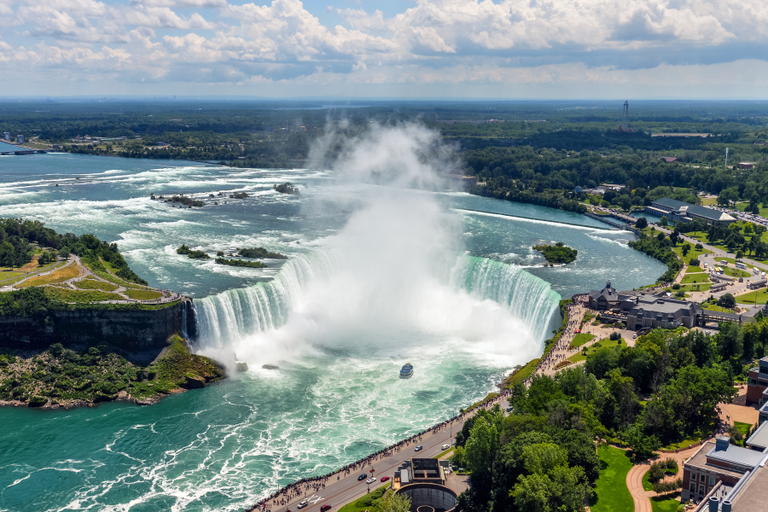
The list of the top 10 attractions in Toronto is incomplete without the famous Niagara Falls. Just 90 minutes away from Toronto, Niagara falls is a group of three waterfalls that lie on the border of Ontario and New York state (USA). As expected, you will be greeted with stunning views, exciting trails and hikes, guided tours, and plenty of staying and eating options nearby.
The Journey Behind the Falls is an opportunity to see the falls from inside out via tunnels that lead to observation points. It’s pretty exciting when you consider how much water is crashing down.
TIP: Helicopter rides can be easily arranged to get the best views.
3D scanning is the process of assessing a real-world item or atmosphere to gather three dimensional data of its form and perhaps its appearance (e. g. shade). The collected data can then be utilized to build digital 3D models. A 3D scanner can be based on various technologies, each with its very own limitations, advantages and expenses. Numerous constraints in the type of things that can be digitised are still present. As an example, optical modern technology might run into numerous troubles with dark, shiny, reflective or clear things. As an example, industrial calculated tomography scanning, structured-light 3D scanners, LiDAR and Time Of Trip 3D Scanners can be utilized to build digital 3D versions, without devastating screening. Collected 3D information works for a wide range of applications. These tools are utilized thoroughly by the entertainment industry in the production of movies and video games, consisting of digital fact. Various other usual applications of this innovation consist of enhanced truth, movement capture, motion recognition, robot mapping, commercial style, orthotics and prosthetics, reverse engineering and prototyping, high quality control/inspection and the digitization of social artefacts.
.Lidar (, additionally LIDAR, LiDAR or LADAR, a phrase of "light detection and ranging" or "laser imaging, discovery, and varying") is a method for establishing ranges by targeting an object or a surface area with a laser and determining the moment for the reflected light to go back to the receiver. Lidar might run in a fixed instructions (e. g., upright) or it may scan numerous instructions, in which situation it is called lidar scanning or 3D laser scanning, an unique mix of 3-D scanning and laser scanning. Lidar has earthbound, air-borne, and mobile applications. Lidar is generally made use of to make high-resolution maps, with applications in checking, geodesy, geomatics, archaeology, location, geology, geomorphology, seismology, forestry, climatic physics, laser advice, airborne laser swathe mapping (ALSM), and laser altimetry. It is utilized to make digital 3-D depictions of locations on the Planet's surface and sea bottom of the intertidal and close to seaside area by differing the wavelength of light. It has additionally been progressively made use of in control and navigation for independent cars and for the helicopter Ingenuity on its record-setting trips over the surface of Mars. The advancement of quantum technology has given rise to the development of Quantum Lidar, showing higher performance and level of sensitivity when compared to conventional lidar systems.
.Toronto is one of the most heavily populated city in Canada and the funding city of the Canadian province of Ontario. With a population of 2,794,356 in 2021, it is the fourth-most populated city in North America. The city is the anchor of the Golden Horseshoe, a metropolitan jumble of 9,765,188 individuals (since 2021) bordering the western end of Lake Ontario, while the Greater Toronto Location proper had a 2021 populace of 6,712,341. Toronto is an international centre of business, money, arts, sporting activities, and culture and is just one of one of the most multicultural and multicultural cities on the planet. Indigenous individuals have actually travelled with and occupied the Toronto location, situated on a wide sloping plateau intermixed with rivers, deep gorges, and city woodland, for more than 10,000 years. After the generally disputed Toronto Purchase, when the Mississauga gave up the location to the British Crown, the British developed the town of York in 1793 and later designated it as the capital of Upper Canada. During the War of 1812, the community was the site of the Battle of York and suffered heavy damages by American troops. York was relabelled and incorporated in 1834 as the city of Toronto. It was assigned as the funding of the district of Ontario in 1867 throughout Canadian Confederation. The city proper has considering that expanded past its original limits through both addition and amalgamation to its present area of 630. 2 km2 (243. 3 sq mi). The varied population of Toronto reflects its existing and historical duty as an important destination for immigrants to Canada. Concerning fifty percent of its homeowners were born beyond Canada and over 200 ethnic beginnings are represented amongst its citizens. While most of Torontonians speak English as their main language, over 160 languages are talked in the city. The mayor of Toronto is elected by direct prominent ballot to work as the president of the city. The Toronto City Board is a unicameral legal body, comprising 25 councillors considering that the 2018 local election, standing for geographical wards throughout the city. Toronto is a popular centre for songs, theatre, movie manufacturing, and television manufacturing, and is home to the head office of Canada's significant national broadcast networks and media electrical outlets. Its varied social establishments, which include many galleries and galleries, festivals and public events, entertainment areas, nationwide historical sites, and sports activities, bring in over 43 million travelers annually. Toronto is understood for its numerous skyscrapers and skyscrapers, specifically the CN Tower, the tallest free standing structure on land beyond Asia. The city is home to the Toronto Stock Exchange, the headquarters of Canada's 5 largest financial institutions, and the head office of many large Canadian and multinational corporations. Its economic situation is extremely diversified with strengths in innovation, design, economic solutions, life scientific researches, education, arts, style, aerospace, ecological innovation, food services, and tourism. Toronto is the third-largest technology center in The United States and Canada after Silicon Valley and New York City City, and the fastest-growing hub.
.


High quality 3D laser scanning services. Thank you Alex for your responsiveness and professionalism of work! You're best!

Needed a 3D laser scanning service done on a commercial building downtown in old Toronto. Alex was really helpful and provided a draft of a Scan-to-BIM model. Will certainly use their services again on my future projects. Really appreciate the work Marc and Alex

We needed a 3D laser scanning service to create a quick CAD draft of our warehouse facility. The iscano team came through on a tight schedule. The data collected really helped us out. We'll certainly use them again.
After data capture, Iscano Toronto employs advanced software tools to process, analyze, and visualize the 3D point cloud data, providing clients with actionable insights and deliverables.
Projects such as building renovations, site surveys, as-built documentation, facility management, historical preservation, and product design can benefit from 3D laser scanning services provided by Iscano Toronto.
Yes, Iscano Toronto can provide case studies and examples of past projects across various industries to showcase the capabilities and benefits of 3D laser scanning services.