When we think about the development of safety and security requirements on Montreal structure and construction sites, we must initially understand the traditional safety methods that have functioned as the bedrock for market practices for decades. What is Changing Safety Criteria on Montreal Building Sites? Discover the Revolutionary Influence of 3D Scanning! . These methods incorporate a series of steps, consisting of using individual safety tools (PPE), adherence to building codes, regular safety and security training, and on-site danger assessments. While these procedures have definitely contributed to lowering work environment accidents and injuries, they have inherent constraints that have prompted the search for even more innovative solutions like 3D scanning modern technology.
Standard security procedures, such as the use of hard hats, harness, and steel-toed boots, are created to protect workers from immediate physical threats. Building codes aid ensure that structures are sound and that the products and techniques utilized throughout building meet established safety and security requirements. However, these codes are frequently responsive, transforming in response to previous incidents rather than expecting brand-new hazards. Safety and security training, while necessary, can promptly end up being outdated as brand-new threats emerge and as the complexity of construction jobs boosts.
Among the key restrictions of traditional precaution is their reliance on human watchfulness and conformity. Despite the most thorough training, human error remains a significant threat factor. Workers may accidentally bypass safety and security procedures because of time restrictions, absence of understanding, or straightforward oversight. Moreover, traditional approaches for threat assessment and inspection can be lengthy and may not record every potential risk, specifically in complicated or dynamically changing environments.
Go into 3D scanning technology, a revolutionary device that is redefining security requirements on building websites in Montreal and around the world. 3D scanning uses a real-time, exact depiction of the building site, allowing for the identification of prospective hazards that may be missed out on by the human eye. This innovation can produce detailed digital models of the building and construction atmosphere, which can be analyzed to enhance site layout, employee movement, and even simulate emergency situations.
The adoption of 3D scanning technology addresses a number of restrictions of conventional safety and security procedures. For example, it minimizes the reliance on hand-operated assessments and the connected human mistake by giving precise and regular information. It enables aggressive risk identification, permitting the mitigation of threats prior to they result in accidents. The technology likewise promotes much better preparation and communication among all stakeholders, as the electronic designs can be easily shared and updated in real-time.
Furthermore, 3D scanning can be incorporated with various other sophisticated technologies like Structure Details Modeling (BIM) and Enhanced Reality (AR) to enhance training and give workers with a more immersive understanding of possible threats. This combination not just
The building and construction industry in Montreal, like numerous various other cities around the globe, has traditionally been filled with risks coming from unpredictabilities in planning, implementation, and upkeep of constructing sites. Yet, as we sail into a period punctuated by technical innovations, we witness the advanced impact of 3D scanning-- a game-changer in the area of building and construction and safety criteria.
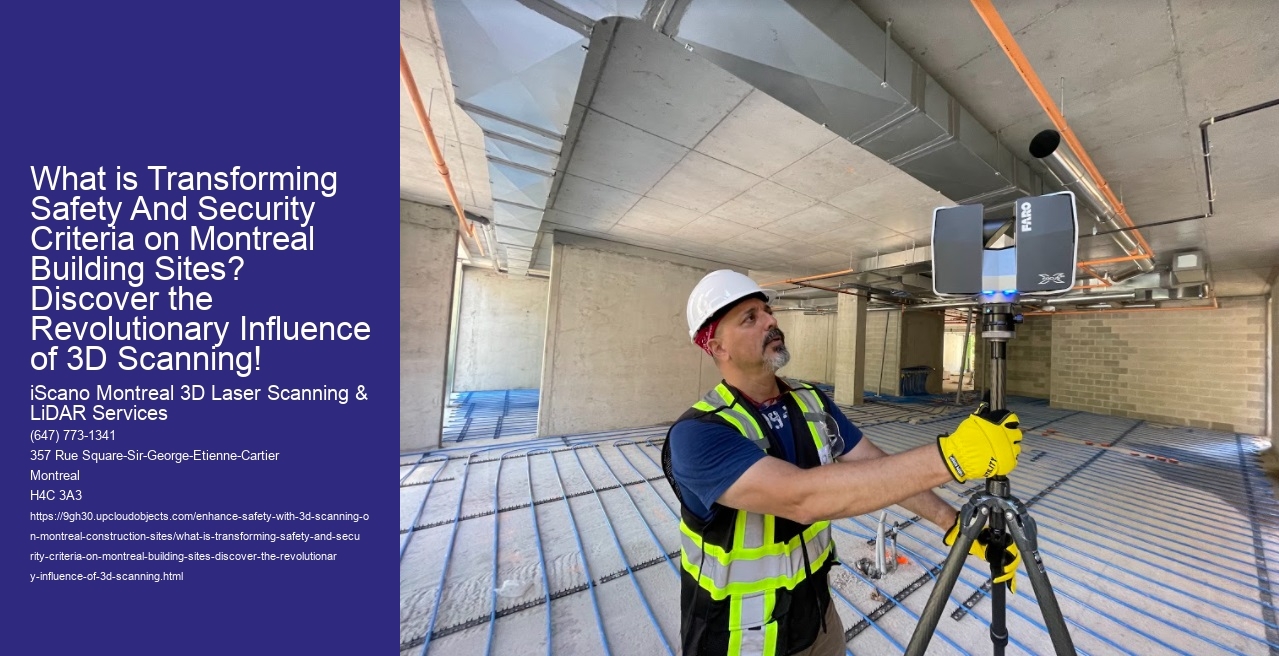
3D scanning, a technology that catches the form of physical items making use of laser light, has begun to leave an indelible mark on how contractors, engineers, and security examiners approach their craft in Montreal. This modern technology provides detailed three-dimensional digital versions of buildings, frameworks, and also entire building and construction sites, which are important for determining and alleviating risks before they intensify right into pricey or unsafe situations.
The impact of 3D scanning on safety and security standards is multifaceted. Initially, it allows accurate and comprehensive site evaluations. Standard checking methods, which are typically time-consuming and subject to human mistake, pale in contrast to the swift and accurate information procurement abilities of 3D scanners. With high-resolution models, prospective issues such as architectural weak points, layout variances, or unforeseen barriers can be found beforehand, permitting punctual restorative measures.
Additionally, 3D scanning promotes a positive safety society. By incorporating 3D models right into Building Info Modeling (BIM) systems, job stakeholders can simulate numerous construction stages, anticipate outcomes, and identify risks connected to functional designs, devices placement, and operations. This predictive approach to safety can dramatically reduce crashes and injuries, as potential dangers are attended to before they manifest on the physical site.
Another aspect of 3D scanning's impact is its payment to the upkeep and renovation of existing structures. Montreal's architectural heritage, consisting of both historic and modern buildings, requires cautious conservation. 3D scanning assists in the assessment of these frameworks, finding wear and tear or damages that may jeopardize safety. Subsequently, prompt interventions can be intended and implemented with accuracy, making certain the long life and safety of the city's built environment.
The fostering of 3D scanning modern technologies has additionally demanded changes in regulatory frameworks. Safety standards in Montreal are evolving to incorporate making use of electronic versions as component of conformity confirmation. Inspectors are currently equipped with innovative tools to visualize and analyze complicated information, bring about more educated decision-making and enforcement of safety regulations.
Furthermore, the labor force itself is undergoing a transformation, as the capability needed for modern-day construction work increases to include technological efficiency. Educating programs and accreditations are increasingly emphasizing the capacity to
The construction market in Montreal, similar to the rest of the globe, is experiencing a standard change in safety and security requirements, driven by the arrival of cutting-edge innovations. Amongst these, 3D scanning has emerged as a revolutionary impact, transforming the method structure and building and construction sites run. This brief essay looks into the successful execution of 3D scanning on Montreal websites, checking out exactly how this innovation is redefining safety and security methods and setting new standards for the industry.
Over the last few years, Montreal has experienced a wave of building tasks focused on city renewal and framework development. With the city's rich heritage and busy metropolitan landscape, building and construction sites are often nestled within complicated atmospheres, where the margin for error is marginal. Traditional safety and security techniques, while effective to a degree, have been incapable to completely eliminate the risks connected with such detailed projects.
Go into 3D scanning-- a technology that records electronic depictions of physical rooms with remarkable precision. Its impact on website security is complex. Firstly, it promotes precise preparation and threat analysis before any manual labor starts. By producing a precise digital twin of the website, task managers can determine potential hazards and design reduction techniques proactively.
One of the study showcasing the effective execution of 3D scanning in Montreal is the improvement of a historical building in the city's midtown core. The intricacy of the structure's framework, integrated with the need to protect its building integrity, made standard checking approaches both dangerous and lengthy. Nonetheless, with 3D scanning, the project group was able to rapidly and securely draw up the structure's attributes, permitting accurate reconstruction job that complied with rigorous security criteria.
Another study includes the building and construction of a brand-new high-rise growth. In this instance, 3D scanning was utilized to keep an eye on the site's development in real-time, making sure that each phase of building and construction followed the job's specifications. This not just enhanced safety by minimizing the possibility of architectural errors however additionally boosted the effectiveness of the construction process itself.
Furthermore, 3D scanning has had an extensive impact on employee safety. By offering in-depth visualizations of the site, workers can be informed more effectively on prospective threats. Training sessions augmented with 3D versions permit workers to familiarize themselves with their working environment, understand the spatial relationships in between different components on the site, and navigate even more confidently and safely.
The data accumulated from 3D scans additionally contributes to the maintenance and evaluation procedures. It allows anticipating upkeep, where potential concerns can be determined and resolved prior to they rise right into
In the ever-evolving landscape of Montreal's building and construction industry, security requirements are not simply a matter of compliance, but a keystone of sustainable and responsible advancement. Amidst this background of regular enhancement, the assimilation of 3D scanning technology is transforming the method safety and security protocols are executed and kept track of, advertising a brand-new age of accuracy and effectiveness.
As regulatory adjustments are introduced to boost the safety and security criteria, 3D scanning becomes an essential device in the toolbox of building administration. Typically, safety and security assessments and website analyses relied heavily on manual procedures that were lengthy and susceptible to human error. Today, however, the adoption of 3D scanning standards is transforming these methods, using a degree of detail and precision that was when unattainable.
The advanced impact of 3D scanning on Montreal's construction websites can be seen in multiple facets. To start with, it makes it possible for the development of accurate electronic depictions of structures, frameworks, and building websites. These comprehensive versions supply a detailed summary of the physical area, allowing for precise planning and analysis that can recognize prospective security hazards before they become a reality.
Secondly, 3D scanning help in checking the architectural honesty of buildings throughout the building process. By comparing scans gradually, engineers and safety and security specialists can spot minute shifts or changes that might indicate a threat of architectural failing. This proactive approach ensures that concerns can be resolved promptly, mitigating risks to workers and the public.
Furthermore, the information gathered via 3D scanning can be used to develop digital reality simulations, offering an immersive training setting for building employees. This hands-on experience is indispensable, equipping workers with the knowledge to browse complicated websites securely and respond effectively to possible risks.
The governing changes that are being executed in Montreal are not just boosting safety standards however are additionally encouraging the building industry to embrace ingenious modern technologies like 3D scanning. With these standards in place, building companies are incentivized to buy innovative scanning tools and training, thereby focusing on the well-being of their labor force.
To conclude, the fostering of 3D scanning criteria in Montreal's building and building websites is a testament to the city's commitment to safety and security and technology. By accepting these regulative changes, the construction market is set on a path to drastically lower accidents and boost the total safety of its operations. The outcome is a much safer environment for building and construction workers and the public, and a more durable and forward-thinking industry that sets a standard for others to adhere to.
In the vibrant globe of construction, safety stands as a vital worry. The market is no stranger to the risks that feature the territory, from dizzying heights to the bustle of hefty machinery. In Montreal, a city that prides itself on its architectural heritage and growing horizon, the quest for improved safety methods is unending. Amongst the most up to date innovations revolutionizing security requirements on building and construction websites is the advent of 3D scanning modern technology. This development is not simply changing safety measures; it's reshaping the very nature of training and ability development in the building and construction sector.
3D scanning-- a technology that captures digital representations of physical things and settings-- has become a game-changer. It permits accurate dimensions, thorough website assessments, and the development of virtual versions that can be evaluated and controlled without physical intervention. The implications for safety and security are profound. By making use of 3D scans, building and construction specialists can recognize potential dangers prior to they become hazardous, simulate emergency situation circumstances, and design much safer workplace.
Nevertheless, the combination of 3D scanning into building practices calls for a new set of skills and an extensive training routine. It's inadequate to merely recognize the basics of building and construction; employees and managers need to now end up being experienced at running advanced scanning devices, analyzing intricate information sets, and using this knowledge to boost safety and security procedures.
Educating programs have actually been established to resolve these needs, incorporating academic knowledge with functional, hands-on experience. Individuals discover just how to run 3D scanners, procedure and envision the gathered information, and integrate this details into their workflow. They are instructed to identify the early signs of structural weak points or misalignments that can bring about crashes. In addition, this innovation makes it possible for the creation of comprehensive safety and security plans customized to specific project requirements, permitting much more effective communication of potential dangers and the measures in place to mitigate them.
Ability growth does not stop at safety. Using 3D scanning in the building and construction market also promotes innovation in project monitoring, style, and quality assurance. As employees come to be efficient in this innovation, they are outfitted to contribute to more efficient and precise construction practices, decreasing the chance of errors that might jeopardize safety and security.
The impact of 3D scanning on security requirements in Montreal's construction sector is certainly advanced. It demands a rethinking of traditional training approaches and a visibility to constant understanding. As the innovation develops, so too need to the industry's technique to safety and skill advancement. Those who embrace this evolution will certainly not only protect their labor force yet will likewise stand at the center of a smarter
The Future of Building Security: Forecasts and Potential Developments
As we aim to the future of building and construction security, especially on Montreal building and building sites, it is clear that technological improvements are set to play a transformative duty. Amongst these innovations, 3D scanning innovation sticks out as a revolutionary influence that is poised to redefine security standards in the industry.
3D scanning, with its capacity to capture detailed and precise depictions of physical rooms, offers numerous benefits for construction safety and security. By producing exact electronic designs of construction websites, 3D scanners enable much better planning and risk assessment prior to any type of physical work begins. This innovative level of prep work can significantly decrease the possibility of crashes, as potential hazards can be determined and minimized in the virtual environment.
In Montreal, the unification of 3D scanning into building process is transforming how safety is come close to from the ground up. For example, by mimicing complicated tasks in a 3D design, website supervisors can guarantee that employees have a clear and extensive understanding of the tasks available, along with any involved threats. This assists in customizing safety training to be more site-specific and efficient, resulting in a more educated and cautious workforce.
Moreover, the use of 3D scanning helps with the continual tracking of building progress, allowing the timely discovery of inconsistencies from the initial plan that may present brand-new security risks. By maintaining an electronic eye on the architectural honesty and spatial restraints of a building site, task supervisors can proactively attend to concerns prior to they rise right into security events.
Predictions for the future of building security in Montreal additionally consist of the combination of 3D scanning information with various other advanced innovations such as Structure Information Modeling (BIM), virtual reality (VIRTUAL REALITY), and boosted reality (AR). The combination of these tools can produce immersive training situations, permit virtual walk-throughs of hazardous areas, and also offer real-time information to workers through wearable technology, ensuring that security information is accessible right when and where it is needed.
Furthermore, as the regulatory landscape develops, it is prepared for that future security standards may require making use of technologies like 3D scanning to maintain conformity. This would certainly ensure a baseline degree of danger administration that profits every person involved, from the individual employees to the construction firms and the broader neighborhood in Montreal.
Finally, the future of building and construction safety and security in Montreal is on the cusp of a technological revolution, with 3D scanning at the forefront. This technology not just enhances the capacity to preemptively attend to safety worries but additionally complements various other digital devices
See also: Municipal history of Quebec
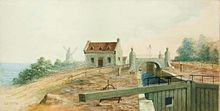
View of Lachine Canal in 1826, a year after it opened. It bypassed the rapids west of the city, linking Montreal with other continental markets.
Montreal was incorporated as a city in 1832.[63] The opening of the Lachine Canal permitted ships to bypass the unnavigable Lachine Rapids,[64] while the construction of the Victoria Bridge established Montreal as a major railway hub. The leaders of Montreal's business community had started to build their homes in the Golden Square Mile from about 1850. By 1860, it was the largest municipality in British North America and the undisputed economic and cultural centre of Canada.[65][66]
In the 19th century, maintaining Montreal's drinking water became increasingly difficult with the rapid increase in population. A majority of the drinking water was still coming from the city's harbour, which was busy and heavily trafficked, leading to the deterioration of the water within. In the mid-1840s, the City of Montreal installed a water system that would pump water from the St. Lawrence and into cisterns. The cisterns would then be transported to the desired location. This was not the first water system of its type in Montreal, as there had been one in private ownership since 1801. In the middle of the 19th century, water distribution was carried out by "fontainiers". The fountainiers[clarification needed] would open and close water valves outside of buildings, as directed, all over the city. As they lacked modern plumbing systems it was impossible to connect all buildings at once and it also acted as a conservation method. However, the population was not finished rising — it rose from 58,000 in 1852 to 267,000 by 1901.[67][68][69]
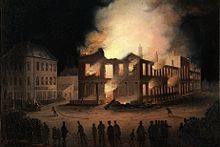
Political protests from Tories led to the burning of the Parliament Buildings in Montreal in 1849.
Montreal was the capital of the Province of Canada from 1844 to 1849, but lost its status when a Tory mob burnt down the Parliament building to protest the passage of the Rebellion Losses Bill.[70] Thereafter, the capital rotated between Quebec City and Toronto until in 1857, Queen Victoria herself established Ottawa as the capital due to strategic reasons. The reasons were twofold. First, because it was located more in the interior of the Province of Canada, it was less susceptible to attack from the United States. Second, and perhaps more importantly, because it lay on the border between French and English Canada, Ottawa was seen as a compromise between Montreal, Toronto, Kingston and Quebec City, which were all vying to become the young nation's official capital. Ottawa retained the status as capital of Canada when the Province of Canada joined with Nova Scotia and New Brunswick to form the Dominion of Canada in 1867.[citation needed]
An internment camp was set up at Immigration Hall in Montreal from August 1914 to November 1918.[71]
3D scanning is the procedure of examining a real-world object or setting to accumulate 3 dimensional data of its shape and possibly its look (e. g. shade). The accumulated information can then be utilized to build digital 3D models. A 3D scanner can be based upon many different modern technologies, each with its own restrictions, benefits and expenses. Many restrictions in the type of items that can be digitised are still existing. As an example, optical modern technology might run into numerous difficulties with dark, shiny, reflective or clear items. For instance, industrial calculated tomography scanning, structured-light 3D scanners, LiDAR and Time Of Trip 3D Scanners can be utilized to build electronic 3D models, without destructive testing. Gathered 3D information works for a wide variety of applications. These devices are used extensively by the show business in the production of movies and video games, including digital fact. Other usual applications of this innovation include increased reality, activity capture, gesture acknowledgment, robot mapping, industrial layout, orthotics and prosthetics, reverse design and prototyping, quality control/inspection and the digitization of social artefacts.
.Montreal is the largest city in the district of Quebec, the second-largest in Canada, and the ninth-largest in The United States and Canada. Established in 1642 as Ville-Marie, or "City of Mary", it is now named after Mount Royal, the triple-peaked hill around which the very early negotiation was developed. The city is centred on the Island of Montreal and a couple of, much smaller, outer islands, the biggest of which is Î& Icirc; le Bizard. The city is 196 km (122 mi) eastern of the national funding, Ottawa, and 258 km (160 mi) southwest of the rural capital, Quebec City. As of 2021, the city had a populace of 1,762,949, and a metropolitan populace of 4,291,732, making it the second-largest metropolitan area in Canada. French is the city's main language. In 2021, 85. 7% of the populace of the city of Montreal considered themselves fluent in French while 90. 2% might talk it in the city. Montreal is one of one of the most multilingual cities in Quebec and Canada, with 58. 5% of the populace able to speak both French and English. Historically the business capital of Canada, Montreal was gone beyond in populace and economic stamina by Toronto in the 1970s. It remains a crucial centre of art, culture, literary works, movie and television, songs, commerce, aerospace, transportation, financing, drugs, technology, layout, education, tourist, food, style, computer game development, and globe events. Montreal is the area of the head office of the International Civil Aeronautics Organization, and was named a UNESCO City of Design in 2006. In 2017, Montreal was rated the 12th-most comfortable city on the planet by the Financial expert Intelligence Unit in its yearly Worldwide Liveability Position, although its ranking slid to 40th in the 2021 index, mainly due to stress on the medical care system from the COVID-19 pandemic. It is frequently ranked as one of the 10 best cities worldwide to be a college student in the QS Globe College Rankings. In 2018, Montreal was placed as an international city. Montreal has actually organized various vital global occasions, consisting of the 1967 International and Universal Exposition, and is the only Canadian city to have hosted the Summertime Olympics, having done so in 1976. The city holds the Canadian Grand Prix of Formula One; the Montreal International Jazz Event, the largest jazz event on the planet; the Simply for Laughs celebration, the biggest funny celebration worldwide; and Les Francos de Montréal, the largest French-language music event on the planet. In sports, it is home to numerous professional groups, most especially the Canadiens of the National Hockey Organization, who have won the Stanley Cup a record 24 times.
.Lidar (, additionally LIDAR, LiDAR or LADAR, a phrase of "light discovery and varying" or "laser imaging, detection, and ranging") is an approach for establishing arrays by targeting an object or a surface area with a laser and gauging the moment for the shown light to go back to the receiver. Lidar might run in a fixed direction (e. g., vertical) or it might scan multiple instructions, in which instance it is known as lidar scanning or 3D laser scanning, a special mix of 3-D scanning and laser scanning. Lidar has terrestrial, airborne, and mobile applications. Lidar is commonly utilized to make high-resolution maps, with applications in surveying, geodesy, geomatics, archaeology, geography, geology, geomorphology, seismology, forestry, climatic physics, laser guidance, airborne laser swathe mapping (ALSM), and laser altimetry. It is made use of to make digital 3-D representations of locations on the Planet's surface area and ocean base of the intertidal and near coastal area by varying the wavelength of light. It has also been progressively made use of in control and navigation for self-governing autos and for the helicopter Ingenuity on its record-setting flights over the terrain of Mars. The advancement of quantum technology has actually triggered the development of Quantum Lidar, showing higher performance and level of sensitivity when contrasted to conventional lidar systems.
.


I requested a 3D laser scanning service in downtown Montreal by the iScano team for a 3D BIM CAD modelling job. Was very impressed about their professionalism and speed. Will certainly request them for additional architectural jobs.

Marc and Brendan, in the iScano team helped us out in a job in Montreal for a 2D and 3D CAD with a facade markup. Brendan and Marc were fast, fair priced and knowledgable in their 3D Laser scanning services. Will use their service again in our construction site.

Provided us a great 3D scanning service. Gave us a scan to BIM project in downtown Montreal. Will use again!
iScano's advanced technology aids in the modernization of infrastructure projects by providing precise data for efficient planning and execution in Montreal.
iScano Montreal's expertise includes navigating and overcoming challenges presented by Montreal's urban landscape, ensuring accurate and reliable 3D scanning results.